Visual Puzzles
Sharpen your observation and pattern-spotting skills with Visual Puzzles quizzes. You’ll tackle images, shapes, and tricky details that test logic, spatial reasoning, and attention to detail - one question at a time.
Quizzes
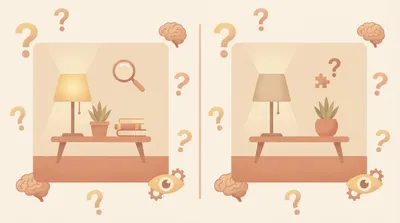

What you'll find here
- Curated quizzes focused on Visual Puzzles
- Difficulty spread from easy to hard
- Randomized questions with instant feedback
- Quizzes you can replay and compare on the leaderboard
See this category in other languages
Category FAQ
How many quizzes are available?
There are 3 quizzes with 232 questions total.
Do Visual Puzzles quizzes have a timer?
No. Each question has 4 options and no timer, so you can take your time.
What kinds of visual puzzles are included?
Expect patterns, odd-one-out images, rotations, reflections, and missing-piece style questions.
Are the quizzes suitable for beginners?
Yes. Quiz difficulty varies, so you can start easy and work up to more complex visual logic.
How many questions are there in this category?
This category includes 232 questions across 3 quizzes.
More to explore
What you’ll practice
Visual puzzles train careful observation, spatial reasoning, and the ability to notice small differences under distraction.
You’ll work through pattern sequences, odd-one-out images, rotations, reflections, and “what’s missing?” style challenges.
How the quizzes work
Each question is multiple-choice with 4 options and no timer, so you can think through the image before you answer.
Quizzes vary in length and difficulty, moving from quick wins to harder items that require multi-step visual logic.
Tips and interesting context
Many classic visual puzzle types overlap with cognitive tests used in education and hiring, such as matrix reasoning and mental rotation tasks.
- Scan the whole image first, then zoom in on edges, corners, and repeated elements - Look for rule changes: size, count, orientation, shading, and symmetry - Eliminate options that break the most obvious pattern before guessing - Use mental “grid lines” to compare spacing and alignment - If stuck, describe the pattern in words; it often reveals the rule n ## Keep improving
Replaying similar puzzle types helps you build a toolkit of common visual rules, making new questions faster to solve.