Ratios and rates in real life
Use ratios and rates the way you actually meet them in real life: shopping deals, recipes, speed, and unit pricing. With mixed difficulty, you’ll get quick wins and a few stretch questions to build co...
Start Quiz
Pick a difficulty and question count to begin.
About this quiz
What you’ll practice
Ratios and rates show up everywhere - from comparing prices to scaling a recipe - so this quiz focuses on everyday scenarios you can picture.
Each question is multiple-choice with 4 options and no timer, so you can take time to set up the relationship, simplify, and check units.
Difficulty and quiz settings
Difficulty is mixed on purpose: you’ll see straightforward ratio comparisons alongside multi-step unit-rate and proportional reasoning problems.
Before you start, choose how many questions you want to answer and select a difficulty level that matches your comfort zone (or keep it mixed for a balanced workout).
Common pitfalls to avoid
- Mixing up part-to-part and part-to-whole ratios
- Forgetting to keep units consistent (minutes vs hours, grams vs kilograms)
- Dividing the wrong way when finding a unit rate
- Simplifying incorrectly or skipping a common factor
- Rounding too early and drifting away from the exact value
Tips for better accuracy
Write the ratio in words first ("dollars per item" or "miles per hour"), then translate it into numbers; it helps prevent reversed rates.
When you’re stuck between two options, estimate quickly to see which answer is reasonable before doing the full calculation.
Sample questions
If a recipe calls for 2 cups of flour to make 4 cookies, how many cups of flour are needed for 12 cookies?
- A.6
- B.4
- C.5
- D.8
A car travels 300 miles using 10 gallons of gas. What is the unit rate of miles per gallon?
- A.30 miles per gallon
- B.25 miles per gallon
- C.35 miles per gallon
- D.40 miles per gallon
If 3 apples cost $2.25, what is the cost of 1 apple?
- A.$0.75
- B.$0.50
- C.$1.00
- D.$1.25
Quiz FAQ
How many questions are in this quiz?
This quiz has 111 questions covering real-life ratios, rates, and unit-rate situations.
Is there a timer on the questions?
No. The quiz has no timer, so you can work carefully and double-check your units.
What is the question format?
Every question is multiple-choice with 4 options, designed for quick checking and clear practice.
How do I choose question count and difficulty?
Use the start panel to select how many questions you want to answer and pick a difficulty level, or keep it mixed for variety.
What kinds of real-life topics are included?
Expect unit pricing, speed, time, recipes, scaling, and other proportional reasoning scenarios common in middle school math.
Related Quizzes
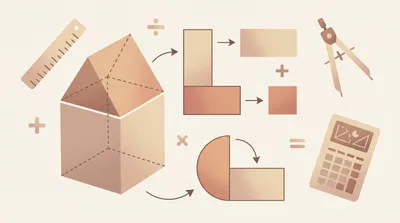
Area and volume of composite shapes
Break composite shapes into familiar parts and calculate area, surface area, and volume with confidence. This mixed-difficulty quiz helps you practice choosing the right formulas, keeping units consistent, and combining results correctly. Pick your preferred question count and difficulty, then learn from each attempt at your own pace.

Integers: operations and absolute value
Sharpen your integer skills with practice on operations, signs, and absolute value. You’ll work through real middle-school style problems that mix quick calculations with number-line thinking. Choose your preferred question count and difficulty, then build confidence step by step.

What happens next in scenes?
Think you can predict the next beat in a family-movie scene? This quiz drops you into familiar moments and asks what happens next, based on context clues, character habits, and classic storytelling. Pick your answer and see how well you remember the setup-to-payoff rhythm.

Brain lobes and core functions
Map the brain’s major lobes to what they do in everyday thinking and behavior. This mixed-difficulty quiz checks your grasp of frontal, parietal, temporal, and occipital functions, plus key “core” structures. Each question uses 4 options and there’s no timer, so you can focus on accuracy.

Guess the song from emoji clues
Decode emoji riddles into real songs in this playful music challenge. Each clue hints at a title, lyric, or artist reference - your job is to connect the icons to the track. With a mixed difficulty set, you’ll see both instant classics and trickier brain-teasers.

Guess the song from one lyric
Can you name the track from a single lyric? This mixed-difficulty quiz spans classics, pop hits, rock anthems, and modern chart-toppers, all with just one line to go on. Pick your preferred question count and difficulty, then see how many songs you can recognize on sight.