Seating arrangements with constraint clues
Test your logic with seating arrangement puzzles built around constraint clues like “next to,” “opposite,” and “between.” Each question asks you to deduce the only valid layout from the information gi...
Start Quiz
Pick a difficulty and question count to begin.
About this quiz
What this quiz is about
Seating arrangement puzzles turn short clue sets into a single consistent layout - perfect for practicing structured deduction. You’ll work with classic constraints (left/right, adjacent, across, ends, and relative positions) and learn to eliminate impossibilities quickly.
Every question is multiple-choice with 4 options and no timer, so you can focus on clean reasoning instead of rushing. Before you start, choose your preferred question count and difficulty; “Mixed” blends easier warm-ups with more involved grids and multi-condition chains.
Skills you’ll practice
- Translating clues into a simple diagram or table
- Tracking “must be” vs. “cannot be” placements without losing constraints
- Using elimination to narrow options when several layouts seem plausible
- Spotting hidden implications (e.g., if A is not next to B, what that forces)
- Checking a full arrangement for consistency before locking an answer
Common pitfalls and how difficulty is balanced
Many wrong answers come from flipping left/right perspectives, assuming a fixed starting point when none is given, or forgetting that “between” usually implies strict order. The difficulty stays fair by mixing single-constraint questions with multi-step ones, and by offering options that reflect common mistake patterns - so you can learn from near-misses.
If a puzzle feels dense, slow down and validate each clue against your draft layout; one contradiction is enough to discard an option. Over time, you’ll recognize recurring structures (pairs, blocks, and forced ends) that make even hard sets manageable.
Sample questions
If A is sitting to the left of B and C is sitting to the right of A, who is sitting in the middle?
- A.A
- B.B
- C.C
- D.None of these
In a row of 5 seats, if D is seated at the end and E is next to D, who can be in the middle?
- A.B or C
- B.A
- C.D
- D.E
If F is between G and H, and I is to the right of H, where is F seated?
- A.To the left of I
- B.To the right of G
- C.At the end
- D.In the middle
Quiz FAQ
How many questions are in this quiz?
This quiz has 100 questions focused on seating arrangements with constraint clues.
What format are the questions in?
Each question is multiple-choice with 4 options, and there is no timer.
How do Mixed difficulty questions work here?
Mixed difficulty combines straightforward clue sets with more complex multi-step arrangements to keep practice balanced.
Can I choose how many questions to play?
Yes. You can select your preferred question count before starting, depending on how long you want to practice.
What’s the most common mistake in seating arrangement puzzles?
Players often misread left/right orientation or assume a fixed starting seat when the clues don’t specify one.
Play this quiz in another language(7)
Related Quizzes
Truth-tellers and liars: consistent statements
Step into classic truth-teller and liar logic where every statement must fit a consistent world. You’ll test whether sets of claims can all be true, all be false, or only work under specific roles. Expect a mix of quick deductions and multi-step consistency checks.
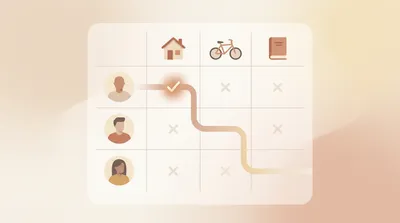
Who owns what in logic grids
Test your logic-grid instincts with “who owns what” deduction puzzles. Each question asks you to match people, items, and clues without guessing. Choose how many questions you want and pick an easier or tougher mix to fit your practice session.

What happens next in scenes?
Think you can predict the next beat in a family-movie scene? This quiz drops you into familiar moments and asks what happens next, based on context clues, character habits, and classic storytelling. Pick your answer and see how well you remember the setup-to-payoff rhythm.

Brain lobes and core functions
Map the brain’s major lobes to what they do in everyday thinking and behavior. This mixed-difficulty quiz checks your grasp of frontal, parietal, temporal, and occipital functions, plus key “core” structures. Each question uses 4 options and there’s no timer, so you can focus on accuracy.

Guess the song from emoji clues
Decode emoji riddles into real songs in this playful music challenge. Each clue hints at a title, lyric, or artist reference - your job is to connect the icons to the track. With a mixed difficulty set, you’ll see both instant classics and trickier brain-teasers.

Guess the song from one lyric
Can you name the track from a single lyric? This mixed-difficulty quiz spans classics, pop hits, rock anthems, and modern chart-toppers, all with just one line to go on. Pick your preferred question count and difficulty, then see how many songs you can recognize on sight.