Acids and bases: pH, pOH, and neutralization
Test your understanding of acids and bases with questions on pH, pOH, Ka/Kb ideas, and neutralization. You’ll practice quick calculations, concept checks, and reaction reasoning from mixed difficulty....
Start Quiz
Pick a difficulty and question count to begin.
About this quiz
What you’ll practice
From pH and pOH calculations to neutralization reactions, this quiz targets the core skills you need for high school chemistry tests.
Expect a mix of numeric problems and concept questions, including acid/base strength, ions in solution, and what “neutral” really means in different contexts.
Quiz format and difficulty
Each question comes with 4 options and there’s no timer, so you can focus on method over speed.
Choose how many questions you want to answer and select a difficulty setting; “Mixed” blends easier fundamentals with tougher multi-step items to keep practice balanced.
Common pitfalls to avoid
Many mistakes come from sign errors and incorrect relationships between pH and pOH, or from assuming strong/weak behavior without checking the substance.
Watch your significant figures and powers of ten, and be careful when converting between [H+], [OH−], pH, and pOH.
- Mixing up pH + pOH = 14 (at 25°C) and applying it blindly at all temperatures
- Forgetting that strong acids/bases dissociate (nearly) completely while weak ones do not
- Dropping the negative sign when taking logs, or misreading scientific notation
- Treating “neutralization” as always producing pH 7 (it depends on acid/base strength and salts)
- Ignoring limiting reactants in titration-style neutralization problems
How to improve quickly
After each question, review why the correct option works and why the distractors are tempting - this is where most learning happens.
If you miss a calculation, redo it slowly once, then try a similar question at a slightly higher difficulty to lock in the process.
Sample questions
What is the pH of pure water at 25 degrees Celsius?
- A.7
- B.0
- C.14
- D.10
Which of the following is a strong acid?
- A.Hydrochloric acid (HCl)
- B.Acetic acid (CH3COOH)
- C.Citric acid (C6H8O7)
- D.Carbonic acid (H2CO3)
What is the pH range of acidic solutions?
- A.0 to 6
- B.7 to 14
- C.6 to 8
- D.8 to 10
Quiz FAQ
How many questions are in this quiz?
This quiz has 102 questions covering pH, pOH, acids/bases, and neutralization.
Does the quiz include both calculations and concepts?
Yes. You’ll see pH/pOH math alongside conceptual questions about strength, dissociation, and reaction outcomes.
Is there a timer?
No timer is used, so you can take your time and focus on accuracy and method.
What answer format does each question use?
Every question is multiple-choice with 4 options.
How is the difficulty balanced on Mixed?
Mixed combines straightforward definitions and conversions with multi-step neutralization and log-based calculation problems.
Play this quiz in another language(7)
Related Quizzes
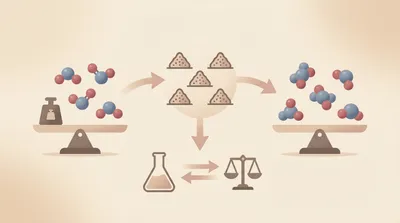
Stoichiometry: mole-to-mole and mass conversions
Strengthen your stoichiometry skills with mole-to-mole and mass conversion practice based on balanced chemical equations. Work through mixed-difficulty questions that build confidence with ratios, molar mass, and unit setup. Pick how many questions you want and the difficulty level, then learn from each attempt - no timer pressure.
Balancing chemical equations with coefficients
Get faster and more accurate at balancing chemical equations using coefficients. You’ll practice conserving atoms, spotting polyatomic ions, and scaling reactions cleanly. Choose your preferred question count and difficulty, then work at your own pace with no timer.

What happens next in scenes?
Think you can predict the next beat in a family-movie scene? This quiz drops you into familiar moments and asks what happens next, based on context clues, character habits, and classic storytelling. Pick your answer and see how well you remember the setup-to-payoff rhythm.

Brain lobes and core functions
Map the brain’s major lobes to what they do in everyday thinking and behavior. This mixed-difficulty quiz checks your grasp of frontal, parietal, temporal, and occipital functions, plus key “core” structures. Each question uses 4 options and there’s no timer, so you can focus on accuracy.

Guess the song from emoji clues
Decode emoji riddles into real songs in this playful music challenge. Each clue hints at a title, lyric, or artist reference - your job is to connect the icons to the track. With a mixed difficulty set, you’ll see both instant classics and trickier brain-teasers.

Guess the song from one lyric
Can you name the track from a single lyric? This mixed-difficulty quiz spans classics, pop hits, rock anthems, and modern chart-toppers, all with just one line to go on. Pick your preferred question count and difficulty, then see how many songs you can recognize on sight.