Canada’s road to Confederation
Trace the political debates, regional tensions, and key conferences that led to Canada’s Confederation. This mixed-difficulty quiz spans major figures, dates, and legislation from the 1840s to 1867 an...
Start Quiz
Pick a difficulty and question count to begin.
About this quiz
What you’ll explore
Follow the path from the Act of Union through responsible government, the Great Coalition, and the Charlottetown/Quebec/London conferences. Questions also touch on regional interests, economic pressures, and how the new Dominion was designed to work.
Every question uses 4 options and there’s no timer, so you can focus on careful reading rather than speed. Before you start, choose how many questions you want and set difficulty to match your comfort level - Mixed blends easier recall with tougher interpretation.
Skills you’ll practice
You’ll strengthen timeline thinking, cause-and-effect reasoning, and recognition of key people, parties, and provinces/colonies involved in Confederation. Expect a mix of factual checks (dates, terms, conference outcomes) and broader understanding (why compromises were needed).
- Placing events like the conferences and key acts in the correct order
- Matching figures to roles (delegates, premiers, reformers, opponents)
- Understanding federal vs. provincial powers and why they were divided
- Spotting economic and security motives (trade, railways, defence)
- Interpreting common terms such as “responsible government” and “rep by pop”
Common pitfalls and how difficulty stays fair
Many misses come from mixing up conference locations, confusing similar political titles, or assuming all regions supported Confederation in the same way. The difficulty is balanced by combining straightforward identification questions with a smaller set that asks you to connect motives, compromises, and outcomes - so steady fundamentals will carry you through.
Sample questions
Which year did Canada officially become a federation?
- A.1867
- B.1776
- C.1840
- D.1901
What was the first colony to join Confederation?
- A.Ontario
- B.Quebec
- C.Nova Scotia
- D.New Brunswick
Who is known as the 'Father of Confederation'?
- A.John A. Macdonald
- B.George Brown
- C.Louis Riel
- D.Wilfrid Laurier
Quiz FAQ
How many questions are in this quiz?
This quiz has 127 questions covering Canada’s road to Confederation.
What time period does the quiz focus on?
It centers on the lead-up to 1867, with some questions on earlier reforms and immediate post-Confederation outcomes.
Is the quiz timed?
No. There’s no timer, and each question has 4 answer options.
How do I choose the length and difficulty?
Use the start settings to pick your question count and select a difficulty level; Mixed provides a balanced spread.
What are common mistakes to watch for?
Players often confuse conference details, mix up political roles, or overlook regional differences in support and concerns.
Related Quizzes

Indigenous nations and U.S. expansion
Trace how Indigenous nations shaped, resisted, and negotiated U.S. expansion across North America. You’ll move from early contact and treaty-making to removal, reservation policy, and continued sovereignty struggles. Expect a mixed-difficulty set that rewards careful reading of events, places, and key terms.
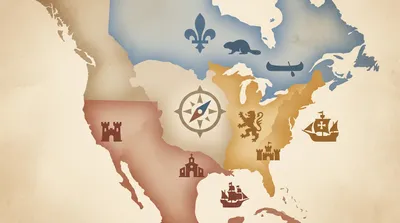
Colonial North America: France, Britain, and Spain
Trace the rivalry and alliances that shaped colonial North America under France, Britain, and Spain. This mixed-difficulty quiz spans exploration, settlement patterns, trade, conflict, and diplomacy. Choose how many questions you want and the difficulty level, then test your recall with four-option questions and no timer pressure.

What happens next in scenes?
Think you can predict the next beat in a family-movie scene? This quiz drops you into familiar moments and asks what happens next, based on context clues, character habits, and classic storytelling. Pick your answer and see how well you remember the setup-to-payoff rhythm.

Brain lobes and core functions
Map the brain’s major lobes to what they do in everyday thinking and behavior. This mixed-difficulty quiz checks your grasp of frontal, parietal, temporal, and occipital functions, plus key “core” structures. Each question uses 4 options and there’s no timer, so you can focus on accuracy.

Guess the song from emoji clues
Decode emoji riddles into real songs in this playful music challenge. Each clue hints at a title, lyric, or artist reference - your job is to connect the icons to the track. With a mixed difficulty set, you’ll see both instant classics and trickier brain-teasers.

Guess the song from one lyric
Can you name the track from a single lyric? This mixed-difficulty quiz spans classics, pop hits, rock anthems, and modern chart-toppers, all with just one line to go on. Pick your preferred question count and difficulty, then see how many songs you can recognize on sight.