Stamp collecting basics: parts and terms
Learn the core vocabulary of philately with this Stamp collecting basics quiz on parts and terms. You’ll identify features like perforations, gum, watermark, and cancellations, and match common catalo...
Start Quiz
Pick a difficulty and question count to begin.
About this quiz
What you’ll practice
This quiz builds your confidence with stamp anatomy and everyday philatelic terminology, from margins and perforations to overprints and cancellations. You’ll also get comfortable with the words collectors use in listings and catalogs, so descriptions make sense at a glance.
Every question uses 4 options and there’s no timer, making it easy to slow down and learn from mistakes. Before you start, pick how many questions you want to answer and select a difficulty level - Mixed blends easy definitions with trickier, look-alike terms.
Common pitfalls to avoid
Many wrong answers come from mixing up similar concepts (like perforation vs. roulette, or watermark vs. paper type) or confusing stamp condition terms with design parts. Watch for wording that hints at placement (front vs. back) and whether a term describes printing, paper, or postmark.
- Confusing the stamp’s design elements with postmark/cancel features
- Mixing condition terms (hinged, mint, used) with physical parts (gum, selvage)
- Overlooking direction/position terms (top margin, corner, center, edge)
- Misreading catalog abbreviations and assuming they’re always about value
- Treating similar production terms as interchangeable (overprint vs. surcharge)
How the difficulty stays balanced
Difficulty is paced by alternating straightforward definitions with identification questions that test close reading. Mixed mode keeps the challenge fair by revisiting key terms often, while still introducing less-common vocabulary so you steadily expand your collector’s toolkit.
Sample questions
What is the term for the raised design on a stamp?
- A.Relief
- B.Engraving
- C.Offset
- D.Lithograph
What do we call the part of the stamp that is printed with the postage value?
- A.Denomination
- B.Face value
- C.Price tag
- D.Cost label
Which term describes a stamp that has not been used?
- A.Mint
- B.Used
- C.Cancelled
- D.Defective
Quiz FAQ
How many questions are in this quiz?
This quiz has 122 questions on stamp parts, features, and collecting terms.
What format are the questions in?
Each question is multiple-choice with 4 options, and there is no timer.
Can I choose the number of questions I answer?
Yes. Set your preferred question count before starting to control the quiz length.
How does Mixed difficulty work here?
Mixed combines easy definitions with more detailed terminology and common look-alike terms.
What mistakes do players commonly make on this topic?
People often confuse similar terms (like perforation vs. roulette) or mix condition words with physical stamp parts.
Play this quiz in another language(7)
Related Quizzes
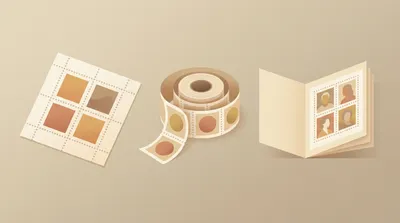
Stamp formats: sheets, coils, and booklets
Learn how stamp issues are packaged and sold across sheets, coils, and booklets. You’ll spot the telltale clues - perforations, selvage, plate numbers, and booklet panes - so you can identify formats confidently. Mixed difficulty keeps it friendly for beginners while still testing seasoned collectors.

Stamp eras: classic to modern issues
Travel through stamp history from classic issues to modern releases in this mixed-difficulty quiz. You’ll spot era clues in designs, printing styles, denominations, and themes. Pick your preferred question count and difficulty, then test how well you can place stamps in their time period.

What happens next in scenes?
Think you can predict the next beat in a family-movie scene? This quiz drops you into familiar moments and asks what happens next, based on context clues, character habits, and classic storytelling. Pick your answer and see how well you remember the setup-to-payoff rhythm.

Brain lobes and core functions
Map the brain’s major lobes to what they do in everyday thinking and behavior. This mixed-difficulty quiz checks your grasp of frontal, parietal, temporal, and occipital functions, plus key “core” structures. Each question uses 4 options and there’s no timer, so you can focus on accuracy.

Guess the song from emoji clues
Decode emoji riddles into real songs in this playful music challenge. Each clue hints at a title, lyric, or artist reference - your job is to connect the icons to the track. With a mixed difficulty set, you’ll see both instant classics and trickier brain-teasers.
Tactical formations: roles and responsibilities
Test how well you understand soccer tactical formations and what each role is responsible for in and out of possession. From back-four duties to midfield rotations and pressing triggers, this mixed-difficulty quiz checks both terminology and real match situations. Pick your preferred question count and difficulty, then play with no timer and four options per question.