Ecosystems
Explore how living things interact with each other and their environment across different habitats. These Ecosystems quizzes cover energy flow, food webs, nutrient cycles, and biodiversity, helping you connect key ecology terms to real-world examples.
Quizzes
What you'll find here
- Curated quizzes focused on Ecosystems
- Difficulty spread from easy to hard
- Randomized questions with instant feedback
- Quizzes you can replay and compare on the leaderboard
See this category in other languages
Category FAQ
How many quizzes are available?
There are 3 quizzes with 359 questions total.
Are the Ecosystems quizzes timed?
No. Each question has 4 options and there is no timer, so you can work at your own pace.
What topics are covered in these Ecosystems quizzes?
You’ll see questions on food webs, energy flow, trophic levels, nutrient cycles, biomes, biodiversity, and human impacts.
Do the quizzes include different difficulty levels or lengths?
Yes. Quizzes vary in length and difficulty, so you can start with fundamentals and move to more applied ecosystem questions.
Will these quizzes help with school ecology units?
Yes. They’re designed to reinforce common ecology concepts and vocabulary used in middle school, high school, and intro biology courses.
More to explore
What you’ll practice
These quizzes help you review how ecosystems function, from producers and consumers to decomposers, habitats, and ecological niches.
You’ll also practice interpreting relationships like predation, competition, and symbiosis, plus how changes in one part of a system affect the whole.
How the quizzes work
Each question is multiple-choice with 4 options, and there’s no timer - so you can focus on accuracy and understanding rather than speed.
Quiz length and difficulty vary, letting you start with core definitions and move toward more applied questions about ecosystem dynamics and human impacts.
Key topics you’ll see
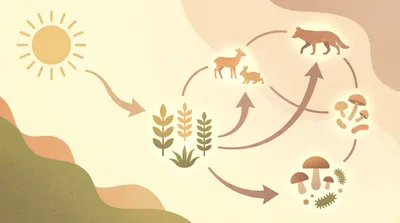
- Food chains, food webs, and trophic levels
- Energy flow and ecological pyramids
- Biomes, habitats, and limiting factors
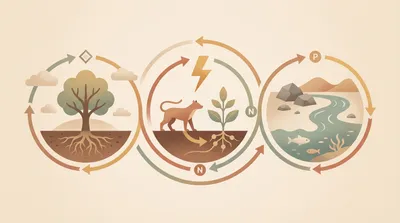
- Nutrient cycles (carbon, nitrogen, water)
- Biodiversity, stability, and succession
- Human impacts such as pollution and habitat loss
Quick ecosystem context
Ecosystems can be tiny (like a puddle) or vast (like a rainforest), but they all rely on energy entering - usually from the sun - and nutrients being recycled through living and non-living components. After major disturbances, many ecosystems follow predictable patterns of succession as species gradually change over time.