Ecological succession after disturbances
Explore how ecosystems rebuild after fires, floods, storms, and human impacts. This quiz covers primary vs. secondary succession, pioneer species, and the shifting roles of soil, nutrients, and compet...
Start Quiz
Pick a difficulty and question count to begin.
About this quiz
What you’ll learn about succession
Disturbances reset ecosystems in different ways, and succession explains the step-by-step recovery that follows. You’ll practice identifying stages, drivers, and outcomes across forests, grasslands, wetlands, and aquatic systems.
Every question uses 4 options and there’s no timer, so you can think through evidence like soil presence, seed sources, and species traits instead of rushing.
Skills you’ll practice
You’ll sharpen your ability to distinguish primary vs. secondary succession, connect disturbance type to recovery speed, and predict which organisms dominate early, mid, and late stages.
You’ll also work with concepts like facilitation, inhibition, and tolerance, plus how nutrient cycling and microclimate changes steer community turnover.
Common pitfalls to avoid
- Mixing up primary succession (no soil) with secondary succession (soil remains)
- Assuming succession always ends in a single “climax” community in every biome
- Forgetting that disturbance severity and frequency can prevent late-stage communities
- Overlooking the role of seed banks, nearby refuges, and dispersal limitations
- Treating pioneer species as “weak” rather than stress-tolerant specialists
Difficulty and question settings
Difficulty is balanced as Mixed: you’ll see straightforward definitions alongside scenario questions that require applying multiple clues. Before you start, choose the question count and select an easier or harder difficulty to match how much practice you want in one session.
Sample questions
What is the initial stage of ecological succession called?
- A.Pioneer stage
- B.Climax stage
- C.Intermediate stage
- D.Decomposer stage
What type of succession occurs in an area with no soil, such as after a volcanic eruption?
- A.Primary succession
- B.Secondary succession
- C.Tertiary succession
- D.Climatic succession
Which of the following is a common pioneer species in primary succession?
- A.Lichens
- B.Maple trees
- C.Foxes
- D.Oaks
Quiz FAQ
How many questions are in this quiz?
This quiz has 124 questions on ecological succession after disturbances.
Is this quiz timed?
No. There is no timer, so you can answer at your own pace.
What answer format does the quiz use?
Each question has 4 multiple-choice options and one best answer.
Can I choose the number of questions and the difficulty?
Yes. You can pick your preferred question count and set the difficulty level before starting.
What topics are covered besides primary and secondary succession?
Expect pioneer species, soil development, disturbance severity, community turnover, and mechanisms like facilitation and inhibition.
Play this quiz in another language(7)
Related Quizzes
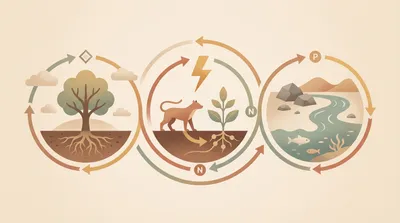
Nutrient cycles: carbon, nitrogen, and phosphorus
Trace how carbon, nitrogen, and phosphorus move through ecosystems and shape life on Earth. This mixed-difficulty quiz checks your understanding of reservoirs, fluxes, and human impacts across land, water, and atmosphere. Choose your preferred question count and difficulty, then learn from each result as you go.
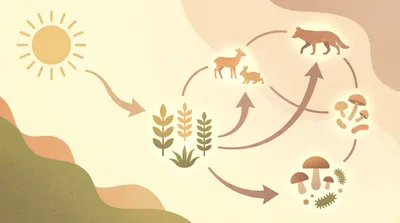
Energy flow in food webs
Trace how energy moves through ecosystems, from producers to top predators and decomposers. This quiz focuses on trophic levels, food chains vs. food webs, and what happens to energy at each transfer. Choose your question count and difficulty, then answer each multiple-choice item at your own pace with no timer.

What happens next in scenes?
Think you can predict the next beat in a family-movie scene? This quiz drops you into familiar moments and asks what happens next, based on context clues, character habits, and classic storytelling. Pick your answer and see how well you remember the setup-to-payoff rhythm.

Brain lobes and core functions
Map the brain’s major lobes to what they do in everyday thinking and behavior. This mixed-difficulty quiz checks your grasp of frontal, parietal, temporal, and occipital functions, plus key “core” structures. Each question uses 4 options and there’s no timer, so you can focus on accuracy.

Guess the song from emoji clues
Decode emoji riddles into real songs in this playful music challenge. Each clue hints at a title, lyric, or artist reference - your job is to connect the icons to the track. With a mixed difficulty set, you’ll see both instant classics and trickier brain-teasers.

Guess the song from one lyric
Can you name the track from a single lyric? This mixed-difficulty quiz spans classics, pop hits, rock anthems, and modern chart-toppers, all with just one line to go on. Pick your preferred question count and difficulty, then see how many songs you can recognize on sight.