Energy flow in food webs
Trace how energy moves through ecosystems, from producers to top predators and decomposers. This quiz focuses on trophic levels, food chains vs. food webs, and what happens to energy at each transfer....
Start Quiz
Pick a difficulty and question count to begin.
About this quiz
What you’ll practice
Energy flow is the backbone of ecosystem science, and this quiz helps you follow it across complex food webs rather than simple chains.
Each question has 4 options and there’s no timer, so you can think through trophic roles, energy loss, and real-world scenarios without rushing.
Difficulty and quiz setup
Difficulty is mixed to keep things balanced: you’ll see quick concept checks alongside more applied questions that combine multiple ideas.
Pick the question count you want before starting, and choose an easier or harder setting if you want to focus on fundamentals or push into trickier web-based reasoning.
Common pitfalls to avoid
Many mistakes come from mixing up energy flow with matter cycling, or assuming energy “recycles” the way nutrients do.
Watch for wording that swaps biomass, energy, and population size - these often change together, but they’re not the same thing.
- Confusing food chains (linear) with food webs (networked)
- Mislabeling trophic levels (producer vs. primary/secondary consumer)
- Forgetting energy is lost as heat at each transfer (10% rule as a guideline)
- Treating decomposers/detritivores as “top predators” instead of recyclers of matter
- Assuming more links in a web means more energy available at higher levels
Tips for scoring higher
When stuck, identify the organism’s role first (producer/consumer/decomposer), then infer where energy is coming from and where it can go next.
If two answers seem close, choose the one that best matches energy transfer direction and the expected drop in available energy up the trophic levels.
Sample questions
What role do producers play in a food web?
- A.They convert solar energy into chemical energy.
- B.They consume other organisms.
- C.They break down dead matter.
- D.They are apex predators.
Which type of organism primarily feeds on producers?
- A.Herbivores
- B.Carnivores
- C.Decomposers
- D.Detritivores
What is the primary source of energy for producers?
- A.Sunlight
- B.Wind
- C.Water
- D.Soil nutrients
Quiz FAQ
How many questions are in this quiz?
This quiz has 117 questions on energy flow in food webs, trophic levels, and ecosystem energy transfer.
Is the Energy flow in food webs quiz timed?
No. There is no timer, so you can answer each question at your own pace.
What answer format does the quiz use?
Every question is multiple-choice with 4 options, and you select the best answer.
How do I choose the number of questions and difficulty?
Before you start, select your preferred question count and pick a difficulty setting; the overall pool is mixed for balanced practice.
What topics are covered besides food chains?
You’ll also see food webs, trophic levels, energy loss between levels, and roles like decomposers and detritivores.
Play this quiz in another language(7)
Related Quizzes
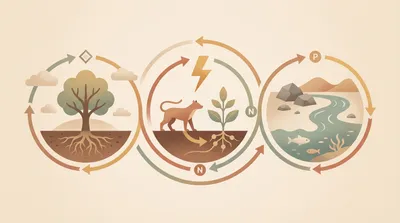
Nutrient cycles: carbon, nitrogen, and phosphorus
Trace how carbon, nitrogen, and phosphorus move through ecosystems and shape life on Earth. This mixed-difficulty quiz checks your understanding of reservoirs, fluxes, and human impacts across land, water, and atmosphere. Choose your preferred question count and difficulty, then learn from each result as you go.
Ecological succession after disturbances
Explore how ecosystems rebuild after fires, floods, storms, and human impacts. This quiz covers primary vs. secondary succession, pioneer species, and the shifting roles of soil, nutrients, and competition over time. Choose your preferred difficulty and question count, then learn through clear, scenario-based questions.
What happens next in scenes?
Think you can predict the next beat in a family-movie scene? This quiz drops you into familiar moments and asks what happens next, based on context clues, character habits, and classic storytelling. Pick your answer and see how well you remember the setup-to-payoff rhythm.

Brain lobes and core functions
Map the brain’s major lobes to what they do in everyday thinking and behavior. This mixed-difficulty quiz checks your grasp of frontal, parietal, temporal, and occipital functions, plus key “core” structures. Each question uses 4 options and there’s no timer, so you can focus on accuracy.

Guess the song from emoji clues
Decode emoji riddles into real songs in this playful music challenge. Each clue hints at a title, lyric, or artist reference - your job is to connect the icons to the track. With a mixed difficulty set, you’ll see both instant classics and trickier brain-teasers.
Guess the song from one lyric
Can you name the track from a single lyric? This mixed-difficulty quiz spans classics, pop hits, rock anthems, and modern chart-toppers, all with just one line to go on. Pick your preferred question count and difficulty, then see how many songs you can recognize on sight.