Elementary Math
Build confidence with core Elementary Math skills, from number sense and arithmetic to fractions, decimals, and basic geometry. These quizzes help you practice step by step and spot common mistakes early.
Quizzes

What you'll find here
- Curated quizzes focused on Elementary Math
- Difficulty spread from easy to hard
- Randomized questions with instant feedback
- Quizzes you can replay and compare on the leaderboard
Category FAQ
How many quizzes are available?
There are 3 quizzes with 390 questions total.
Do these Elementary Math quizzes have a timer?
No. There is no timer, so you can work at your own pace and check your calculations.
How are the questions formatted?
Each question is multiple-choice with 4 answer options.
What topics are covered in Elementary Math here?
You’ll practice core skills like arithmetic, place value, fractions/decimals, measurement, and basic geometry concepts.
Are there different difficulty levels or quiz lengths?
Yes. The quizzes vary in difficulty and length, so you can start with easier sets and progress to more mixed practice.
More to explore
What you’ll practice
These Elementary Math quizzes focus on the building blocks used in later math: place value, operations, fractions, measurement, and simple geometry.
You’ll get targeted practice with both accuracy and reasoning, including word problems that require choosing the right operation.
How the quizzes work
Each question has 4 answer options, and there’s no timer - take as long as you need to calculate and double-check your work.
Quizzes vary in length and difficulty, so you can start with shorter sets for review and move to longer mixed practice as you improve.
Helpful tips while you learn
- Show your work on paper to avoid small arithmetic slips
- Estimate first to catch answers that are too big or too small
- Watch place value when adding, subtracting, or multiplying
- For fractions, simplify and compare using common denominators when needed
- In word problems, underline key numbers and units
Quick facts about elementary math
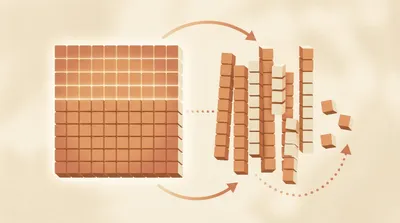
Many elementary methods - like carrying/borrowing, long division, and fraction equivalence - are based on the base-10 place-value system, which makes large numbers manageable with repeating patterns.