Democracy And Elections
Explore how democracies work and how elections translate votes into power. These quizzes cover core ideas like representation, electoral systems, voting rights, and campaign rules, with questions that connect real-world cases to key political concepts.
Quizzes
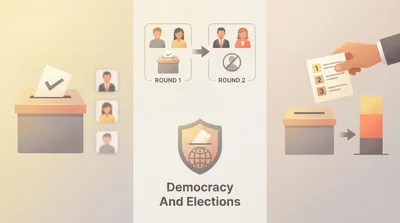


What you'll find here
- Curated quizzes focused on Democracy And Elections
- Difficulty spread from easy to hard
- Randomized questions with instant feedback
- Quizzes you can replay and compare on the leaderboard
Category FAQ
How many quizzes are available?
There are 3 quizzes with 348 questions total.
Do these Democracy And Elections quizzes have a timer?
No. Each question has 4 options and there is no timer, so you can work at your own pace.
What topics are covered in this category?
You’ll see questions on democratic principles, voting rights, electoral systems, campaigns, and how election results translate into representation.
Are the quizzes suitable for beginners and advanced learners?
Yes. The quizzes vary in difficulty and length, so you can start with fundamentals and move to more detailed scenarios.
What skills will I improve by taking these quizzes?
You’ll strengthen your understanding of key concepts and practice applying them to examples, including interpreting rules, outcomes, and fairness issues.
More to explore
What you’ll practice
These quizzes help you review the building blocks of democratic government, from citizen participation and representation to how elections produce legitimate authority.
You’ll also practice reading scenarios and identifying concepts such as majority rule vs. minority rights, electoral fairness, and common election outcomes.
How the quizzes work
Each question has 4 answer options, and there’s no timer, so you can focus on accuracy and learning from mistakes.
Quizzes vary in difficulty and length, letting you choose a quicker review or a longer, more challenging run depending on your goal.
- Key terms: democracy, legitimacy, mandate, turnout, enfranchisement
- Electoral systems: plurality, runoff, proportional representation, mixed systems
- Institutions and rules: districts, ballots, parties, election management bodies
- Rights and integrity: voting rights, access, fraud, security, transparency
- Outcomes and strategy: coalitions, swing voters, incumbency, polarization
Quick context and interesting facts
Many democratic systems use different vote-to-seat formulas, which can produce very different outcomes even with similar vote shares.
Secret ballots, now standard in many countries, were adopted to reduce intimidation and vote buying, but their spread happened gradually over the 19th and 20th centuries.