How elections are run: ballots and counts
Step behind the scenes of modern elections and test how well you understand ballots, counting rules, and reporting results. This mixed-difficulty quiz covers everything from voter intent and spoiled b...
Start Quiz
Pick a difficulty and question count to begin.
About this quiz
What this quiz covers
Elections aren’t just “vote and tally” - they’re a chain of procedures designed to protect accuracy, secrecy, and trust. This quiz explores how ballots are designed, cast, verified, counted, and reported across common election systems.
You’ll answer in a multiple-choice format with 4 options per question and no timer, so you can focus on reasoning rather than speed.
Skills you’ll practice
Expect a mix of practical and civic knowledge: interpreting ballot marks, understanding how votes are aggregated, and spotting where errors or disputes can occur. You’ll also practice distinguishing official results processes from myths and misunderstandings.
- Reading ballot types (paper, optical scan, mail, provisional) and what makes a ballot valid - Following the count workflow: tabulation, canvass, certification, and reporting - Understanding recounts, audits, chain of custody, and transparency safeguards - Recognizing how voter intent is handled when marks are unclear - Comparing plurality vs. ranked-choice counting basics and common outcomes n ## Common pitfalls to avoid
Many mistakes come from mixing up similar terms (audit vs recount, canvass vs certification) or assuming every jurisdiction uses the same rules. Another frequent trap is overlooking how ballot design and voter instructions affect what counts as an overvote, undervote, or spoiled ballot.
Difficulty and question settings
Difficulty is balanced as “Mixed,” blending straightforward definitions with scenario-style questions about edge cases and procedures. You can choose your question count and difficulty before starting to tailor the session - short practice runs for review, or longer sets for deeper mastery.
Sample questions
What is a ballot?
- A.A paper or electronic form used to cast a vote
- B.A type of election result
- C.A voter registration form
- D.A polling place
What is the term for the process of counting votes?
- A.Tabulation
- B.Balloting
- C.Polling
- D.Electioneering
Which document typically explains the voting procedures?
- A.Election guide
- B.Voting rights act
- C.Political manifesto
- D.Voter registration form
Quiz FAQ
How many questions are in this quiz?
This quiz has 115 questions on how elections are run, including ballots, counting, and result certification.
What format are the questions in?
Each question is multiple choice with 4 options, and there is no timer.
Can I change the difficulty or number of questions?
Yes. Before you start, you can choose a question count and select a difficulty level to match your practice goals.
What topics about counting does it include?
It covers tabulation basics, voter intent, overvotes/undervotes, recounts, audits, canvassing, and certification steps.
What are common mistakes players make on this quiz?
Players often confuse audit vs recount, assume one universal rule set, or miss how ballot-marking rules affect validity.
Play this quiz in another language(7)
Related Quizzes
Democratic institutions: checks, rights, and accountability
Test how well you understand the institutions that keep democracy working - courts, legislatures, elections, and independent oversight. This quiz covers checks and balances, civil rights, transparency, and accountability across different systems. Choose your preferred question count and difficulty, then learn from clear explanations as you go.
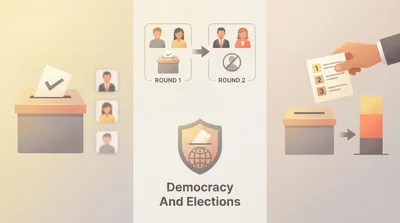
Voting systems: plurality, runoff, and ranked choice
Test how well you understand plurality, runoff, and ranked-choice voting - and what each system rewards. You’ll work through real-world scenarios like vote splitting, majority thresholds, and instant-runoff rounds. Pick your preferred question count and difficulty to study the basics or challenge your election-method intuition.

What happens next in scenes?
Think you can predict the next beat in a family-movie scene? This quiz drops you into familiar moments and asks what happens next, based on context clues, character habits, and classic storytelling. Pick your answer and see how well you remember the setup-to-payoff rhythm.

Brain lobes and core functions
Map the brain’s major lobes to what they do in everyday thinking and behavior. This mixed-difficulty quiz checks your grasp of frontal, parietal, temporal, and occipital functions, plus key “core” structures. Each question uses 4 options and there’s no timer, so you can focus on accuracy.
Guess the song from emoji clues
Decode emoji riddles into real songs in this playful music challenge. Each clue hints at a title, lyric, or artist reference - your job is to connect the icons to the track. With a mixed difficulty set, you’ll see both instant classics and trickier brain-teasers.
Guess the song from one lyric
Can you name the track from a single lyric? This mixed-difficulty quiz spans classics, pop hits, rock anthems, and modern chart-toppers, all with just one line to go on. Pick your preferred question count and difficulty, then see how many songs you can recognize on sight.