Democratic institutions: checks, rights, and accountability
Test how well you understand the institutions that keep democracy working - courts, legislatures, elections, and independent oversight. This quiz covers checks and balances, civil rights, transparency...
Start Quiz
Pick a difficulty and question count to begin.
About this quiz
What this quiz covers
Democratic institutions only work when power is limited, rights are protected, and leaders can be held to account. In this quiz, you’ll move through core ideas like checks and balances, rule of law, civil liberties, and oversight bodies.
Every question comes in a 4-option multiple-choice format with no timer, so you can focus on reasoning rather than speed. You can also choose your question count and set the difficulty to match your comfort level (or keep it mixed for a realistic challenge).
Skills you’ll practice
You’ll practice spotting how institutions interact - who can veto, review, investigate, or remove power, and under what rules. Expect scenarios that ask you to distinguish between legal authority, political norms, and informal pressure.
- Identifying checks and balances between branches of government
- Linking rights (speech, due process, equality) to enforcement mechanisms
- Recognizing accountability tools: audits, inquiries, impeachment, elections
- Separating independent institutions from partisan control and conflicts of interest
- Interpreting transparency and anti-corruption safeguards in public office
Common pitfalls and how difficulty is balanced
A frequent mistake is confusing “popular support” with “legitimacy under the constitution,” or assuming courts always override legislatures in the same way across countries. Another trap is mixing up oversight (monitoring and reporting) with enforcement (sanctions and remedies).
Difficulty is balanced by mixing straightforward definitions with applied questions that require comparing similar concepts (for example, judicial review vs. parliamentary scrutiny). If you want a smoother ramp-up, start on an easier setting with fewer questions, then increase difficulty and length as you improve.
Sample questions
What is the primary purpose of checks and balances in a democracy?
- A.To prevent any one branch of government from becoming too powerful
- B.To ensure all citizens can vote
- C.To establish a monarchy
- D.To eliminate political parties
Which amendment in the U.S. Constitution guarantees freedom of speech?
- A.First Amendment
- B.Second Amendment
- C.Fifth Amendment
- D.Eighth Amendment
What is the main function of a constitution in a democracy?
- A.To outline the framework of government and protect citizens' rights
- B.To write laws
- C.To elect representatives
- D.To collect taxes
Quiz FAQ
How many questions are in this quiz?
This quiz has 126 questions on checks, rights, and accountability in democratic systems.
What format is the quiz in?
Each question is multiple-choice with 4 options, and there is no timer.
Can I choose the number of questions and the difficulty?
Yes. You can select your preferred question count and adjust the difficulty, or keep it mixed for variety.
What topics are included under democratic institutions?
You’ll see checks and balances, civil rights protections, rule of law, transparency, elections, and oversight mechanisms.
What mistakes do players commonly make on this topic?
Many confuse oversight with enforcement, or assume one country’s institutional rules apply universally to all democracies.
Play this quiz in another language(7)
Related Quizzes
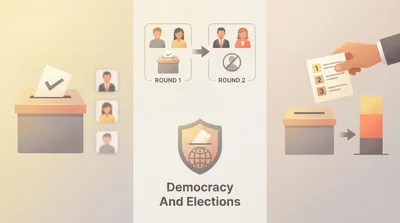
Voting systems: plurality, runoff, and ranked choice
Test how well you understand plurality, runoff, and ranked-choice voting - and what each system rewards. You’ll work through real-world scenarios like vote splitting, majority thresholds, and instant-runoff rounds. Pick your preferred question count and difficulty to study the basics or challenge your election-method intuition.
How elections are run: ballots and counts
Step behind the scenes of modern elections and test how well you understand ballots, counting rules, and reporting results. This mixed-difficulty quiz covers everything from voter intent and spoiled ballots to recounts and audits. Choose your preferred question count and difficulty, then learn as you go with clear multiple-choice prompts.
What happens next in scenes?
Think you can predict the next beat in a family-movie scene? This quiz drops you into familiar moments and asks what happens next, based on context clues, character habits, and classic storytelling. Pick your answer and see how well you remember the setup-to-payoff rhythm.

Brain lobes and core functions
Map the brain’s major lobes to what they do in everyday thinking and behavior. This mixed-difficulty quiz checks your grasp of frontal, parietal, temporal, and occipital functions, plus key “core” structures. Each question uses 4 options and there’s no timer, so you can focus on accuracy.
Guess the song from emoji clues
Decode emoji riddles into real songs in this playful music challenge. Each clue hints at a title, lyric, or artist reference - your job is to connect the icons to the track. With a mixed difficulty set, you’ll see both instant classics and trickier brain-teasers.
Guess the song from one lyric
Can you name the track from a single lyric? This mixed-difficulty quiz spans classics, pop hits, rock anthems, and modern chart-toppers, all with just one line to go on. Pick your preferred question count and difficulty, then see how many songs you can recognize on sight.