Energy forms and conversions in nature
Trace how energy moves through the natural world - from sunlight to food webs, weather, and Earth’s interior. This mixed-difficulty quiz explores forms of energy and the conversions that power everyda...
Start Quiz
Pick a difficulty and question count to begin.
About this quiz
What you’ll explore in this quiz
Energy in nature rarely stays in one form for long, and this quiz helps you follow the “before and after” of common processes like heating, motion, electricity, and chemical reactions.
Each question uses 4 options and there’s no timer, so you can reason through conversions such as radiant to thermal, chemical to kinetic, or gravitational potential to kinetic.
Skills you’ll practice
You’ll strengthen your ability to label energy forms, identify the direction of transfer, and connect real-world examples (ecosystems, weather, geology, and technology) to the correct conversion.
- Distinguishing energy forms: kinetic, thermal, chemical, electrical, radiant, sound, nuclear, and potential
- Tracking conversions across multi-step systems (e.g., Sun → plant → animal → motion/heat)
- Using conservation of energy to rule out impossible answers
- Recognizing where energy “goes” as waste heat due to friction or resistance
- Interpreting everyday scenarios like storms, waterfalls, batteries, and photosynthesis
Common pitfalls to avoid
A frequent mistake is mixing up energy transfer (energy moving between objects) with energy transformation (energy changing form), or assuming all input energy becomes useful output.
Watch for distractors that ignore losses to heat, confuse power with energy, or swap potential and kinetic energy at different points in a process.
Difficulty and question count options
Difficulty is balanced by mixing straightforward identification questions with deeper, multi-step conversion chains, so beginners can build confidence while advanced learners stay challenged.
Before you start, choose your preferred question count and select an easier or harder setting to match your study goal - quick review, full practice, or a thorough self-check.
Sample questions
What form of energy is stored in the bonds of chemical compounds?
- A.Chemical energy
- B.Nuclear energy
- C.Thermal energy
- D.Mechanical energy
Which process converts sunlight into chemical energy in plants?
- A.Photosynthesis
- B.Respiration
- C.Transpiration
- D.Evaporation
What type of energy is associated with the motion of objects?
- A.Kinetic energy
- B.Potential energy
- C.Thermal energy
- D.Electrical energy
Quiz FAQ
How many questions are in this quiz?
This quiz has 122 questions covering energy forms and conversions in nature.
What format are the questions in?
Each question is multiple-choice with 4 options, and there is no timer.
Is the difficulty suitable for beginners?
Yes. The quiz is mixed difficulty, combining basic identification with more complex conversion chains.
Can I choose how many questions to answer?
Yes. You can pick your question count before starting to do a quick run or a longer practice session.
What topics are covered under energy conversions in nature?
You’ll see examples like sunlight and photosynthesis, food webs, friction and heat, weather systems, and potential-to-kinetic changes in moving water or falling objects.
Play this quiz in another language(7)
Related Quizzes

Power, work, and efficiency basics
Build confidence with the core ideas behind power, work, and efficiency. You’ll practice quick calculations, unit conversions, and interpreting everyday energy scenarios. Choose your preferred difficulty and number of questions, then learn from instant feedback as you go.
Heat transfer: conduction, convection, and radiation
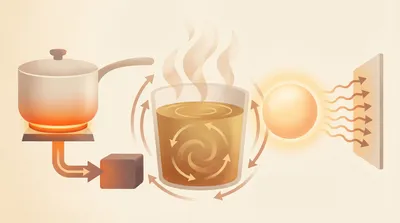
Explore how heat moves in everyday systems and real engineering setups. This mixed-difficulty quiz covers conduction, convection, and radiation with practical examples and key formulas. Build confidence spotting the dominant heat-transfer mode and predicting what changes when materials, geometry, or temperature differences shift.

What happens next in scenes?
Think you can predict the next beat in a family-movie scene? This quiz drops you into familiar moments and asks what happens next, based on context clues, character habits, and classic storytelling. Pick your answer and see how well you remember the setup-to-payoff rhythm.

Brain lobes and core functions
Map the brain’s major lobes to what they do in everyday thinking and behavior. This mixed-difficulty quiz checks your grasp of frontal, parietal, temporal, and occipital functions, plus key “core” structures. Each question uses 4 options and there’s no timer, so you can focus on accuracy.

Guess the song from emoji clues
Decode emoji riddles into real songs in this playful music challenge. Each clue hints at a title, lyric, or artist reference - your job is to connect the icons to the track. With a mixed difficulty set, you’ll see both instant classics and trickier brain-teasers.

Guess the song from one lyric
Can you name the track from a single lyric? This mixed-difficulty quiz spans classics, pop hits, rock anthems, and modern chart-toppers, all with just one line to go on. Pick your preferred question count and difficulty, then see how many songs you can recognize on sight.