Power, work, and efficiency basics
Build confidence with the core ideas behind power, work, and efficiency. You’ll practice quick calculations, unit conversions, and interpreting everyday energy scenarios. Choose your preferred difficu...
Start Quiz
Pick a difficulty and question count to begin.
About this quiz
What you’ll practice
From joules to watts, this quiz targets the essentials: calculating work done, relating power to time, and interpreting efficiency in real systems.
Each question uses 4 options and there’s no timer, so you can focus on method and accuracy rather than speed.
Difficulty and question count
Difficulty is mixed by design: straightforward definitions and unit checks are blended with multi-step word problems to keep the challenge balanced.
Before starting, pick how many questions you want to answer and choose a difficulty setting that matches your comfort level (or keep it mixed for a realistic spread).
Common pitfalls to avoid
- Mixing up energy (J) and power (W), or forgetting that 1 W = 1 J/s
- Using mass instead of weight (remember force in newtons) when computing work
- Missing unit conversions (kW↔W, minutes↔seconds, kWh↔J)
- Ignoring direction/angle in work problems when force isn’t along the motion
- Treating efficiency as a whole number instead of a fraction/percent
Tips to score higher
Write down the formula first, then check units to confirm you’re solving for the right quantity. When a question feels tricky, estimate the order of magnitude before choosing an option to catch obvious conversion errors.
Sample questions
What is the unit of power in the International System of Units (SI)?
- A.Watt
- B.Joule
- C.Newton
- D.Pascal
Which formula represents the relationship between work, force, and distance?
- A.Work = Force x Distance
- B.Work = Force + Distance
- C.Work = Force / Distance
- D.Work = Force - Distance
What is the formula to calculate efficiency?
- A.Efficiency = (Useful Output Energy / Input Energy) x 100%
- B.Efficiency = (Input Energy / Useful Output Energy) x 100%
- C.Efficiency = Output Power / Input Power
- D.Efficiency = Useful Output Work / Input Work
Quiz FAQ
How many questions are in this quiz?
This quiz has 109 questions on power, work, and efficiency fundamentals.
Is there a time limit?
No - there’s no timer, so you can work through calculations at your own pace.
What answer format does the quiz use?
Every question is multiple-choice with 4 options.
Can I choose the difficulty and number of questions?
Yes, you can select your preferred difficulty and decide how many questions to attempt before starting.
What topics are covered most often?
Expect work-energy calculations, power-time relationships, efficiency percentages, and unit conversions like kW, kWh, and J.
Play this quiz in another language(7)
Related Quizzes

Energy forms and conversions in nature
Trace how energy moves through the natural world - from sunlight to food webs, weather, and Earth’s interior. This mixed-difficulty quiz explores forms of energy and the conversions that power everyday phenomena. Pick your preferred question count and difficulty, then test your understanding with clear, classroom-style prompts.
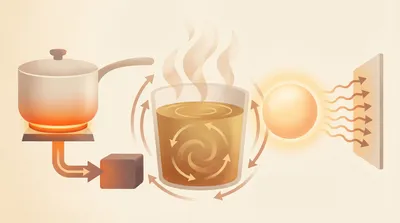
Heat transfer: conduction, convection, and radiation
Explore how heat moves in everyday systems and real engineering setups. This mixed-difficulty quiz covers conduction, convection, and radiation with practical examples and key formulas. Build confidence spotting the dominant heat-transfer mode and predicting what changes when materials, geometry, or temperature differences shift.

What happens next in scenes?
Think you can predict the next beat in a family-movie scene? This quiz drops you into familiar moments and asks what happens next, based on context clues, character habits, and classic storytelling. Pick your answer and see how well you remember the setup-to-payoff rhythm.

Brain lobes and core functions
Map the brain’s major lobes to what they do in everyday thinking and behavior. This mixed-difficulty quiz checks your grasp of frontal, parietal, temporal, and occipital functions, plus key “core” structures. Each question uses 4 options and there’s no timer, so you can focus on accuracy.

Guess the song from emoji clues
Decode emoji riddles into real songs in this playful music challenge. Each clue hints at a title, lyric, or artist reference - your job is to connect the icons to the track. With a mixed difficulty set, you’ll see both instant classics and trickier brain-teasers.

Guess the song from one lyric
Can you name the track from a single lyric? This mixed-difficulty quiz spans classics, pop hits, rock anthems, and modern chart-toppers, all with just one line to go on. Pick your preferred question count and difficulty, then see how many songs you can recognize on sight.