Trade routes: Nile, Levant, and Gulf
Track the goods, ports, and power plays that linked the Nile Valley with the Levant and the Persian Gulf. This mixed-difficulty quiz explores routes by river, coast, and caravan, from key commodities ...
Start Quiz
Pick a difficulty and question count to begin.
About this quiz
What this quiz covers
Trade in the ancient Near East wasn’t one road - it was a network of river travel, coastal shipping, and overland corridors tying Egypt to the Levant and onward to Mesopotamia and the Gulf. You’ll connect regions, commodities, and political control to understand why certain routes mattered.
Each question is multiple-choice with 4 options and no timer, so you can think through geography and chronology instead of rushing. Before you start, pick how many questions you want to answer and set a difficulty level; “Mixed” blends easier recognition items with tougher inference questions.
Skills you’ll practice
You’ll sharpen your ability to place trade routes on a mental map, match goods to their likely origins and destinations, and spot how empires influenced movement through ports, passes, and river chokepoints.
- Tracing Nile-to-Levant and Levant-to-Mesopotamia connections by land and sea
- Identifying common commodities (metals, timber, textiles, incense, grain) and where they moved
- Linking routes to political eras (Old Kingdom, New Kingdom, Assyrian, Babylonian, Persian, etc.)
- Recognizing strategic nodes like ports, river mouths, and caravan hubs
- Distinguishing coastal shipping from inland caravan logistics
Common pitfalls (and how to avoid them)
Many players mix up similarly named regions and assume one “main” route existed in every period; instead, routes shifted with security, diplomacy, and seasonal conditions. Another frequent mistake is treating the Gulf as isolated - questions may test how it connected to broader Mesopotamian exchange.
How difficulty is balanced
The quiz alternates between straightforward recall (key places, basic goods) and higher-level reasoning (why a route was preferred, what changed under a new empire, which chokepoint mattered). Mixed mode is designed to keep momentum while still rewarding careful reading and historical context.
Sample questions
What important trade route connected Egypt to the Levant?
- A.The Via Maris
- B.The Silk Road
- C.The Incense Route
- D.The Trans-Saharan Route
Which of the following goods was commonly traded along the Nile?
- A.Papyrus
- B.Silk
- C.Spices
- D.Precious metals
What was a key trade item from the Gulf region that was sought after in Egypt?
- A.Frankincense
- B.Wool
- C.Cotton
- D.Citrus fruits
Quiz FAQ
How many questions are in this quiz?
This quiz has 176 questions on trade routes linking the Nile, the Levant, and the Gulf.
Is there a timer or time limit?
No - there’s no timer. Every question has 4 options, so you can answer at your own pace.
Can I choose the number of questions and the difficulty?
Yes. Select your preferred question count and difficulty before starting; Mixed blends easy, medium, and hard items.
What topics show up most often?
Expect geography, key ports and corridors, major powers that controlled routes, and the movement of common goods across regions.
What’s the most common mistake players make here?
Confusing nearby regions or assuming routes stayed the same across centuries. Pay attention to period clues and control of chokepoints.
Play this quiz in another language(7)
Related Quizzes
Gods and Myths of Mesopotamia
Journey through the gods, heroes, and monsters of ancient Mesopotamia - from Enlil and Inanna to the Epic of Gilgamesh. This mixed-difficulty quiz blends quick facts with deeper myth connections, so you can test what you know and learn what you missed along the way.
Egyptian Temples and Priesthood Roles
Step inside ancient Egypt’s sacred precincts and explore how temples worked day to day. This quiz covers priestly ranks, rituals, offerings, and the political economy behind major cult centers. Expect a mixed-difficulty set that rewards careful reading and solid historical context.
Akkadian Empire: Sargon and successors
Step into the world of the Akkadian Empire and track how Sargon built power - and how his successors tried to hold it together. This mixed-difficulty quiz explores key rulers, campaigns, administration, and the empire’s legacy across Mesopotamia. Choose your preferred length and difficulty, then test what you really remember.
Hieroglyphs, Cuneiform, and Writing Systems
Trace how ancient people recorded language, power, and trade through signs and symbols. This quiz mixes Egyptian hieroglyphs with Mesopotamian cuneiform and other early writing systems, from materials and tools to how scripts evolved. Expect a blend of quick ID questions and deeper context checks.
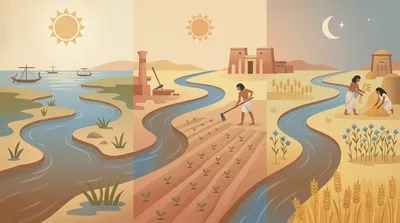
Nile Agriculture and Flood Calendar
Step into the rhythm of ancient Egypt by exploring how the Nile’s floods shaped farming, labor, and the yearly calendar. This mixed-difficulty quiz covers seasons, crops, tools, and administration tied to predictable inundation. Choose your preferred question count and difficulty, then answer each item with 4 options and no timer.
Ziggurats: architecture and civic function
Step into the monumental world of Mesopotamian ziggurats and learn how these tiered temples shaped city life. This mixed-difficulty quiz explores architecture, construction, patronage, and civic roles across Sumer, Akkad, Babylon, and Assyria. Choose your preferred question count and difficulty to study casually or challenge yourself.