Ecology
Explore how living organisms interact with each other and their environment. These Ecology quizzes cover ecosystems, energy flow, nutrient cycles, populations, and biodiversity, with questions designed to build both core definitions and real-world reasoning.
Quizzes


What you'll find here
- Curated quizzes focused on Ecology
- Difficulty spread from easy to hard
- Randomized questions with instant feedback
- Quizzes you can replay and compare on the leaderboard
See this category in other languages
Category FAQ
How many quizzes are available in Ecology?
There are 3 quizzes with 357 questions total.
What topics do the Ecology quizzes cover?
They cover ecosystems, energy flow, food webs, population ecology, nutrient cycles, and biodiversity-related concepts.
How are the questions formatted?
Each question is multiple-choice with 4 options, and there is no timer.
Are the quizzes suitable for different skill levels?
Yes. The 3 quizzes vary in difficulty and length, so you can progress from basics to more applied questions.
What will I improve by taking these quizzes?
You’ll strengthen your understanding of core terms and your ability to reason through ecological scenarios and cause-and-effect relationships.
More to explore
What you’ll practice in Ecology
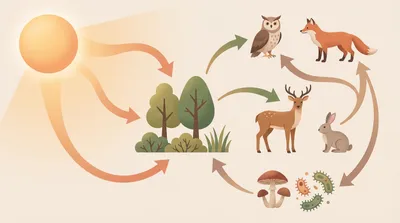
These quizzes help you review key ecology ideas such as ecosystems, food webs, trophic levels, population dynamics, and biogeochemical cycles.
You’ll also practice interpreting simple scenarios (like predator–prey changes or habitat loss) and connecting terms to real environmental outcomes.
How the quizzes work
Each question has 4 multiple-choice options and there’s no timer, so you can focus on accuracy and learning rather than speed.
Difficulty and length vary across the 3 quizzes, so you can start with fundamentals and then move to more applied, multi-step questions as you improve.
Useful ecology facts and context
Ecology links biology to climate, land use, and conservation: small shifts in temperature, nutrients, or species balance can cascade through entire ecosystems.
A classic example is a “keystone species,” where changes to one species can reshape community structure and biodiversity far beyond what its population size suggests.
Quick study checklist
- Know the difference between habitat, niche, population, community, and ecosystem
- Trace energy flow through food chains and food webs (and why energy is lost at each level)
- Recognize major nutrient cycles (carbon, nitrogen, phosphorus) and what disrupts them
- Compare density-dependent vs. density-independent limiting factors
- Interpret basic population growth patterns and carrying capacity