Nutrient cycles: carbon, nitrogen, and phosphorus
Track how carbon, nitrogen, and phosphorus move through ecosystems - from atmosphere and oceans to soils, organisms, and back again. This mixed-difficulty quiz checks key processes, reservoirs, and hu...
Start Quiz
Pick a difficulty and question count to begin.
About this quiz
What you’ll practice
Move confidently between the carbon, nitrogen, and phosphorus cycles by identifying reservoirs, fluxes, and the organisms driving each step. You’ll also connect real-world issues - like eutrophication and climate change - to the underlying biogeochemistry.
Every question uses 4 options and there’s no timer, so you can slow down to reason through pathways, units, and cause-and-effect.
Common pitfalls to avoid
Many learners mix up where each cycle has a major atmospheric component (carbon and nitrogen) versus where it does not (phosphorus). Another frequent slip is confusing similar processes - like nitrification vs. denitrification - or treating decomposition as separate from nutrient cycling.
- Mixing nitrification (NH4+ → NO3−) with denitrification (NO3− → N2)
- Forgetting phosphorus lacks a significant gaseous phase in most models
- Confusing assimilation by plants with mineralization by decomposers
- Overlooking human inputs (fertilizer, fossil fuels) when explaining flux changes
- Treating “reservoir” and “flux” as interchangeable terms
Difficulty and question settings
Difficulty is balanced across the set: you’ll see straightforward definitions, then progressively more applied questions using scenarios (e.g., runoff, algal blooms, soil oxygen levels). Choose your preferred question count and difficulty before starting - short runs are great for quick review, while longer sessions build endurance across all subtopics.
Sample questions
What is the primary process by which carbon enters the atmosphere?
- A.Respiration
- B.Nitrification
- C.Transpiration
- D.Denitrification
Which organism is primarily responsible for nitrogen fixation?
- A.Bacteria
- B.Fungi
- C.Plants
- D.Insects
In what form is phosphorus primarily absorbed by plants?
- A.Phosphate
- B.Phosphite
- C.Organic phosphate
- D.Elemental phosphorus
Quiz FAQ
How many questions are in this quiz?
This quiz has 119 questions covering carbon, nitrogen, and phosphorus cycling.
What format are the questions in?
Each question has 4 answer options and there is no timer, so you can work at your own pace.
Is the difficulty suitable for beginners and advanced learners?
Yes. It’s mixed difficulty, combining foundational concepts with more applied ecology and biogeochemistry scenarios.
Can I choose how many questions to answer?
Yes. You can select your question count and difficulty before you begin to match your study time and goals.
What topics are most emphasized?
Expect reservoirs and fluxes, key processes (fixation, nitrification, denitrification), phosphorus weathering and runoff, and human impacts like eutrophication and CO2 emissions.
Play this quiz in another language(7)
Related Quizzes

Population growth: exponential and logistic
Test your understanding of population growth models in ecology, from rapid exponential increase to logistic growth with carrying capacity. Work through real-world scenarios and graphs to see how limiting factors change growth over time. Mixed difficulty makes it useful for both revision and self-checking.
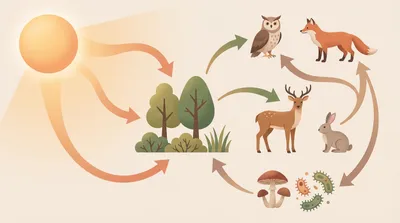
Energy flow in food webs
Trace how energy moves through ecosystems, from producers to top predators and decomposers. This mixed-difficulty quiz checks your understanding of trophic levels, food chains vs. food webs, and why energy is lost at each transfer. Choose your preferred question count and difficulty, then learn from clear, multiple-choice practice.
Genetics Basics: Genes To Traits
Explore how traits are inherited through genes and alleles. Covers Mendelian inheritance, dominant/recessive patterns, and simple Punnett-square reasoning.
Human Body Systems And Functions
Test your knowledge of major human body systems and what they do. Covers organs, system interactions, and basic physiology terms.
Physics: Forces Motion And Energy
Test core physics concepts behind everyday motion. Covers Newton’s laws, friction, work and energy, momentum, and simple conceptual scenarios.

Astronomy: Stars Planets And Galaxies
Check your understanding of objects and processes in space. Covers star life cycles, planet types, galaxies, and basic observational astronomy terms.