Periodic Table
Explore the Periodic Table with quizzes that cover element symbols, atomic numbers, groups, periods, and key trends like electronegativity and reactivity. Great for students and anyone refreshing core chemistry facts and patterns.
Quizzes
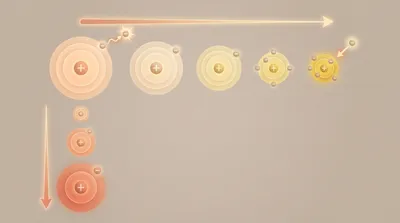

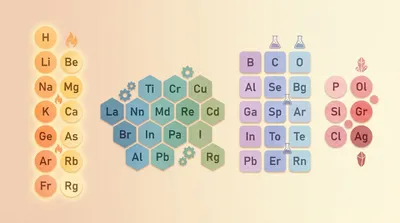
What you'll find here
- Curated quizzes focused on Periodic Table
- Difficulty spread from easy to hard
- Randomized questions with instant feedback
- Quizzes you can replay and compare on the leaderboard
See this category in other languages
Category FAQ
How many quizzes are available?
There are 3 quizzes with 328 questions total.
Do these Periodic Table quizzes have a timer?
No. Each quiz has no timer, so you can work at your own pace.
What question format should I expect?
All questions are multiple-choice with 4 options.
What topics are covered in this category?
Expect element names and symbols, atomic numbers, groups and periods, and periodic trends like electronegativity and atomic radius.
Are the quizzes suitable for different skill levels?
Yes. The set includes a mix of shorter recall questions and more challenging trend and classification questions.
More to explore
What you’ll practice
These Periodic Table quizzes help you recall element names, symbols, and atomic numbers, and connect them to groups, periods, and common properties.
You’ll also practice recognizing periodic trends (like atomic radius, ionization energy, and electronegativity) and how they relate to chemical behavior.
How the quizzes work
Each question is multiple-choice with 4 options, and there’s no timer - so you can focus on accuracy and learning as you go.
Quizzes vary in difficulty and length across the set, so you can start with quick recall and move toward more concept-based trend questions.
Quick context: why the table is arranged this way
The modern periodic table is organized by increasing atomic number, which reveals repeating (periodic) patterns in electron configuration and chemical properties.
Those repeating patterns are why elements in the same group often form similar ions and compounds, even across different periods.
Tips for better scores
- Memorize common element symbols that don’t match English names (e.g., Na, Fe, Ag)
- Use group patterns: alkali metals are highly reactive; noble gases are mostly inert
- Remember trend directions: electronegativity generally increases up and to the right
- Link valence electrons to typical charges for main-group elements
- Practice “neighbors”: elements near each other often have related properties