Periodic trends: size, energy, and affinity
Test how well you understand periodic trends like atomic size, ionization energy, electron affinity, and electronegativity. You’ll compare elements across periods and groups, interpret common exceptio...
Start Quiz
Pick a difficulty and question count to begin.
About this quiz
What you’ll practice
Periodic trends can feel simple until you hit real comparisons, exceptions, and charged species. This quiz focuses on the patterns behind atomic radius, ionization energy, electron affinity, and electronegativity across the periodic table.
Each question uses 4 options and there’s no timer, so you can slow down to reason through shielding, effective nuclear charge, and subshell effects.
Common pitfalls to avoid
Many mistakes come from mixing up “across a period” vs “down a group,” or forgetting that ions change size dramatically compared with their neutral atoms. Another frequent trap is assuming every trend is perfectly smooth without accounting for subshell stability and electron pairing.
How difficulty and length are balanced
Difficulty is mixed: you’ll see straightforward trend direction questions alongside tougher comparisons and exception-based items. Before starting, choose how many questions you want to answer and pick an easier or harder setting to match your current comfort level.
Quick tips for better accuracy
- Remember: atomic radius generally decreases across a period and increases down a group
- For ionization energy, watch for common “dips” tied to subshell starts and electron pairing
- Electron affinity trends are strong but not perfectly uniform; know the notable exceptions
- Compare ions by charge and electron count first, then apply size logic
- When stuck, think in terms of effective nuclear charge vs shielding rather than memorizing arrows
Sample questions
Which of the following elements has the largest atomic radius?
- A.Francium
- B.Helium
- C.Carbon
- D.Oxygen
As you move from left to right across a period, what happens to the atomic radius?
- A.It decreases
- B.It increases
- C.It stays the same
- D.It fluctuates
Which element has the highest electronegativity?
- A.Fluorine
- B.Chlorine
- C.Oxygen
- D.Nitrogen
Quiz FAQ
How many questions are in this quiz?
This quiz has 110 questions covering periodic trends like size, ionization energy, and affinity.
Is the quiz timed?
No. Each question has 4 options and there is no timer, so you can work at your own pace.
What topics are included in periodic trends here?
You’ll practice atomic/ionic radius, ionization energy, electron affinity, electronegativity, and trend exceptions.
Can I choose the difficulty or number of questions?
Yes. You can select a question count before starting and choose a difficulty setting to match your level.
What’s the most common mistake with these trends?
Mixing up across-period vs down-group direction and forgetting how ion charge changes size are the biggest errors.
Play this quiz in another language(7)
Related Quizzes
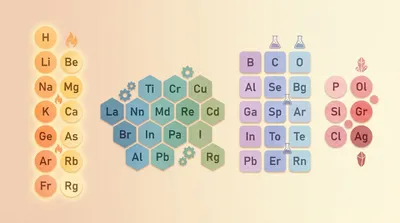
Element families: groups and properties
Test how well you know the periodic table’s element families and what their group placement reveals. Identify key properties, typical ions, and reactivity trends across metals, nonmetals, and metalloids. With mixed difficulty, it’s great for both quick review and deeper practice.

Element symbols: tricky letter pairs
Some element symbols look deceptively similar - especially when two-letter pairs overlap in sound or spelling. This quiz focuses on those tricky letter combinations so you can spot the right symbol fast. Expect a mixed difficulty set that rewards careful reading and solid periodic table recall.
Genetics Basics: Genes To Traits
Explore how traits are inherited through genes and alleles. Covers Mendelian inheritance, dominant/recessive patterns, and simple Punnett-square reasoning.
Human Body Systems And Functions
Test your knowledge of major human body systems and what they do. Covers organs, system interactions, and basic physiology terms.
Physics: Forces Motion And Energy
Test core physics concepts behind everyday motion. Covers Newton’s laws, friction, work and energy, momentum, and simple conceptual scenarios.

Astronomy: Stars Planets And Galaxies
Check your understanding of objects and processes in space. Covers star life cycles, planet types, galaxies, and basic observational astronomy terms.