Element symbols: tricky letter pairs
Some element symbols look deceptively similar - especially when two-letter pairs overlap in sound or spelling. This quiz focuses on those tricky letter combinations so you can spot the right symbol fa...
Start Quiz
Pick a difficulty and question count to begin.
About this quiz
What you’ll practice
Confusing symbol pairs are a classic periodic table trap, and this quiz is built to sharpen your accuracy under “looks-right” pressure. You’ll practice matching element names to the correct one- or two-letter symbols, with extra attention on near-misses.
Each question uses 4 options and there’s no timer, so you can slow down and focus on pattern recognition rather than speed.
Difficulty and choosing your setup
Difficulty is mixed on purpose: easier, high-frequency symbols appear alongside less common ones and lookalike pairs to keep you honest. If the start panel lets you pick question count and difficulty, choose a shorter set for quick drilling or the full 92 for a thorough sweep.
Common pitfalls to avoid
Many mistakes come from swapping letter order, assuming the first two letters of the element name, or overlooking capitalization rules. Another frequent slip is confusing symbols that share the same first letter but differ in the second.
- Watch letter order carefully (e.g., “-r” vs “-l” style mix-ups)
- Don’t assume the symbol matches the first two letters of the name
- Check capitalization: first letter uppercase, second letter (if any) lowercase
- Separate sound-alikes from spelling-alikes; both can trick you
- Use elimination: rule out options that break symbol conventions
Tips for better scores
When you miss one, pause and make a mini-pair in your head (element ↔ symbol) before moving on; that’s where the learning sticks. Replaying with a different question count is a good way to reinforce the hardest pairs without burning out.
Sample questions
What element is represented by the symbol 'H'?
- A.Hydrogen
- B.Helium
- C.Hafnium
- D.Holmium
What element is represented by the symbol 'He'?
- A.Helium
- B.Hydrogen
- C.Hassium
- D.Hafnium
What element is represented by the symbol 'Li'?
- A.Lithium
- B.Lead
- C.Lutetium
- D.Lithosphere
Quiz FAQ
How many questions are in this quiz?
This quiz has 92 questions focused on tricky element symbol letter pairs.
What format does the quiz use?
Every question is multiple-choice with 4 options, and there is no timer.
Is the difficulty beginner-friendly or advanced?
It’s mixed difficulty, blending common symbols with lookalike pairs that are easy to confuse.
Can I change the number of questions or difficulty?
Yes - use the start panel settings to choose your question count and difficulty before you begin.
What mistakes do players make most often here?
Common errors include swapping letter order, assuming the first two letters of the name, and missing capitalization rules.
Play this quiz in another language(7)
Related Quizzes
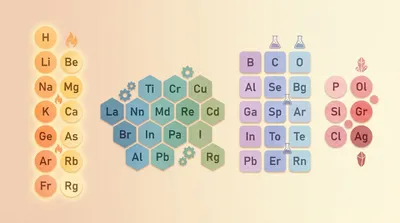
Element families: groups and properties
Test how well you know the periodic table’s element families and what their group placement reveals. Identify key properties, typical ions, and reactivity trends across metals, nonmetals, and metalloids. With mixed difficulty, it’s great for both quick review and deeper practice.
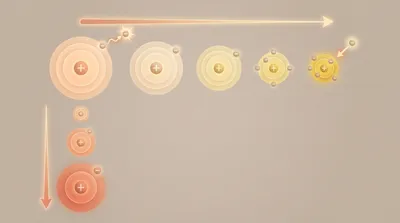
Periodic trends: size, energy, and affinity
Test how well you understand periodic trends like atomic size, ionization energy, electron affinity, and electronegativity. You’ll compare elements across periods and groups, interpret common exceptions, and build faster intuition for trend-based questions. Mixed difficulty keeps it useful for both review and exam prep.
Genetics Basics: Genes To Traits
Explore how traits are inherited through genes and alleles. Covers Mendelian inheritance, dominant/recessive patterns, and simple Punnett-square reasoning.
Human Body Systems And Functions
Test your knowledge of major human body systems and what they do. Covers organs, system interactions, and basic physiology terms.
Physics: Forces Motion And Energy
Test core physics concepts behind everyday motion. Covers Newton’s laws, friction, work and energy, momentum, and simple conceptual scenarios.

Astronomy: Stars Planets And Galaxies
Check your understanding of objects and processes in space. Covers star life cycles, planet types, galaxies, and basic observational astronomy terms.