Element families: groups and properties
Test how well you know the periodic table’s element families and what their group placement reveals. Identify key properties, typical ions, and reactivity trends across metals, nonmetals, and metalloi...
Start Quiz
Pick a difficulty and question count to begin.
About this quiz
What you’ll practice
Element families are the shortcuts to predicting behavior on the periodic table, and this quiz helps you use them confidently. You’ll connect group names to properties like valence electrons, common charges, and typical reactivity.
Expect a mix of recall and reasoning: some questions focus on identifying a family, while others ask you to infer properties from group position. The format is simple - 4 options per question and no timer - so you can focus on accuracy.
Difficulty and question settings
Difficulty is balanced by blending straightforward group facts (like alkali metals vs noble gases) with trend-based prompts that require comparison across periods and groups. Choose your preferred question count and difficulty before you start to tailor the session to quick drilling or full-length revision.
- Recognize major families: alkali metals, alkaline earths, halogens, noble gases, and transition metals
- Predict common ion charges and valence electron patterns by group
- Compare reactivity trends within a family (up vs down a group)
- Distinguish metals, nonmetals, and metalloids using location and properties
- Avoid common mix-ups between group number, period number, and electron shells
Common pitfalls to watch for
A frequent mistake is confusing “group” trends with “period” trends, especially for atomic radius, electronegativity, and ionization energy. Another is assuming every element in a column behaves identically - this is mostly true for main-group elements, but transition metals can vary more.
If you miss a question, use the explanation you’d give in class: name the family, state the valence electron count, then link it to charge and reactivity. That quick chain of reasoning makes the patterns stick.
Sample questions
What is the common name for Group 1 elements?
- A.Alkali metals
- B.Alkaline earth metals
- C.Noble gases
- D.Halogens
Which group contains the elements known as noble gases?
- A.Group 18
- B.Group 1
- C.Group 2
- D.Group 17
What property is characteristic of alkali metals?
- A.They are highly reactive with water.
- B.They are gases at room temperature.
- C.They have a high melting point.
- D.They are good conductors of electricity.
Quiz FAQ
How many questions are in this quiz?
This quiz has 126 questions on element families, groups, and their properties.
What topics are covered in element families and groups?
It focuses on group names, typical properties, valence electrons, common ion charges, and periodic trends tied to families.
What is the quiz format and is there a timer?
Each question has 4 options, and there is no timer so you can work at your own pace.
How do I choose the question count and difficulty?
Before starting, select the number of questions you want and pick a difficulty level; the quiz is mixed by default.
What are common mistakes this quiz helps fix?
It targets mix-ups like confusing groups with periods, misreading trend directions, and overgeneralizing transition-metal behavior.
Play this quiz in another language(7)
Related Quizzes
Element symbols: tricky letter pairs
Some element symbols look deceptively similar - especially when two-letter pairs overlap in sound or spelling. This quiz focuses on those tricky letter combinations so you can spot the right symbol fast. Expect a mixed difficulty set that rewards careful reading and solid periodic table recall.
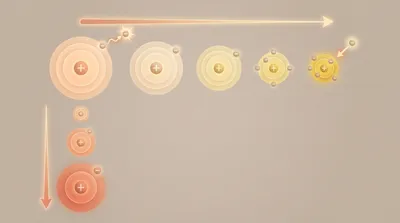
Periodic trends: size, energy, and affinity
Test how well you understand periodic trends like atomic size, ionization energy, electron affinity, and electronegativity. You’ll compare elements across periods and groups, interpret common exceptions, and build faster intuition for trend-based questions. Mixed difficulty keeps it useful for both review and exam prep.
Genetics Basics: Genes To Traits
Explore how traits are inherited through genes and alleles. Covers Mendelian inheritance, dominant/recessive patterns, and simple Punnett-square reasoning.
Human Body Systems And Functions
Test your knowledge of major human body systems and what they do. Covers organs, system interactions, and basic physiology terms.
Physics: Forces Motion And Energy
Test core physics concepts behind everyday motion. Covers Newton’s laws, friction, work and energy, momentum, and simple conceptual scenarios.

Astronomy: Stars Planets And Galaxies
Check your understanding of objects and processes in space. Covers star life cycles, planet types, galaxies, and basic observational astronomy terms.